


161″]
Hip complaints
Veldhoven & Waalre
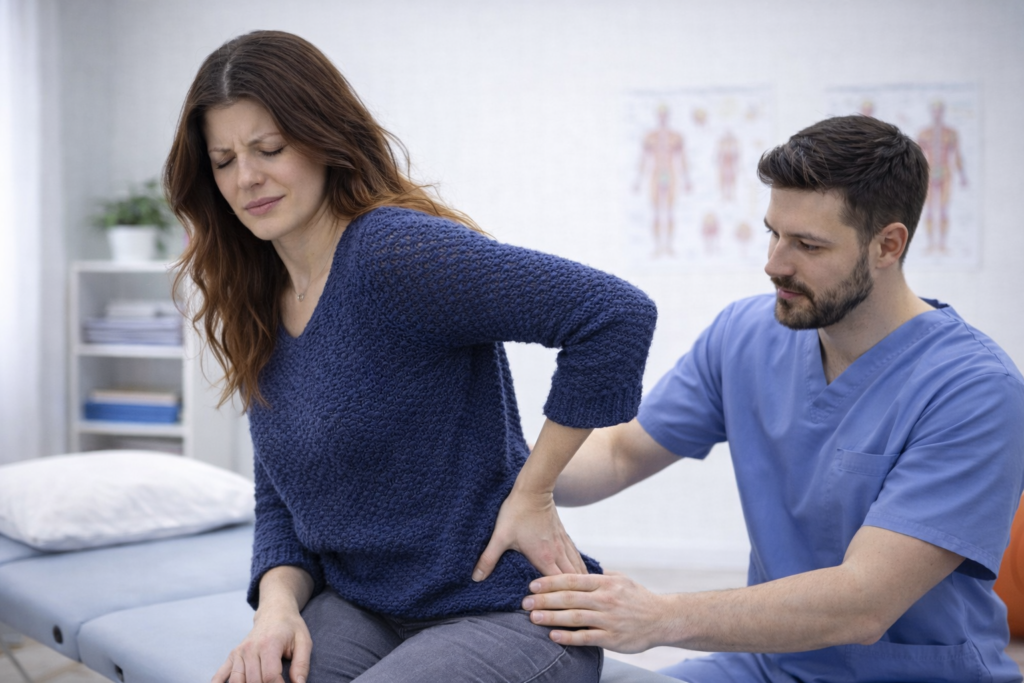
Our therapists guide and treat you to move smoothly, pain-free, and with confidence again. Hip problems can arise from overuse, wear and tear, an injury, or surgery. Depending on the cause, we focus on reducing pain, improving mobility, and restoring muscle strength and stability around the hip.
During the treatment, we work step by step on your recovery. We combine exercise therapy, mobilization techniques, and targeted training to make the hip flexible and strong. In addition, we provide advice on posture, movement, and load capacity, so that you not only recover but also prevent future complaints.

More information
A hip complaint can arise suddenly after trauma such as a fall, but it can also develop gradually without a clearly identifiable cause. Below, we outline several ways it can develop and what physiotherapy can offer in these cases. Hip pain can vary in intensity depending on the injury or condition and from person to person. However, there are typical pain patterns that are characteristic and are explained for each condition.
During activities such as sports, the hip muscles can become injured. A sharp, stabbing pain is characteristic of an acute issue. With a sudden movement, a muscle or tendon can become overstrained, leading to a strain or tear.
In severe cases of a muscle tear or tendon injury, the range of motion will be limited during movement and walking will be painful. Contracting the affected muscle or tendon will worsen the pain, and (localized) swelling may occur. In the case of a rupture, a dent or irregularity can be felt in the muscle. Ultrasound diagnostics can be used to assess the size and severity of the rupture. For more information about ultrasound diagnostics, visit www.shockwaveveldhoven.nl
Treatment: In the case of a rupture or another form of acute injury, medical taping can be applied. In addition, advice is provided and you are guided in resuming (sports) activities. This guidance mainly consists of exercise therapy, and in the final recovery phase, stretching of the affected muscle (if necessary). Another option is the use of shockwave therapy to promote recovery. Shockwave is applied at both locations of Cardo Healthcare.
When vague complaints occur that are not continuously present, it may indicate an overuse of muscle or tendon tissue. In some cases, the bursa may also become inflamed. Being unable to lie on the hip, for example while sleeping, is often an additional symptom indicating a bursa inflammation.
These complaints limit activities such as sports, work, but also daily tasks like dressing and self-care. The most common complaints with hip wear are:
- Pain around the hip that worsens with weight-bearing activities such as walking, climbing stairs, or bending and extending the hip (to the maximum).
- Night pain, especially when lying on the affected hip.
- Stiffness of the hip and loss of mobility. Morning stiffness is a well-known complaint.
- Loss of strength due to weakening of the muscles around the hip joint.
Preoperative: Several studies have confirmed that preoperative exercise has a beneficial effect on recovery after hip surgery. This means that normal hip joint function is regained more quickly and that activities can be resumed earlier. Strengthening the hip muscles through strength training as well as improving fitness will be addressed during the exercise therapy.
Greater trochanter pain syndrome is an irritation of the bursa, a fluid-filled sac that lies over the greater trochanter, a protrusion on the outside of the hip bone (femur), the outermost part of the hip. The bursa acts like a cushion to reduce friction between the outside of the hip bone and the muscles that attach to the bone. The pain syndrome develops when the outside of the hip becomes irritated due to repeated friction against the bursa. This repeated friction is caused by a combination of muscle weakness and stiffness, which increases friction on the outside of the hip. There are several causes that can trigger this irritation:
- Stiffness and/or adhesion of the iliotibial band (a thick band of connective tissue that originates from a muscle in the pelvis and runs along the outside of the leg down to the knee)
- Muscle stiffness or weakness of the hip
- Abnormalities in hip or knee biomechanics (movement)
- Other/new sports activities and stresses
What pain symptoms occur in major pain syndrome?
- Sensitivity to touch on the outside of the hip
- Pain when lying on the affected side, inability to sleep due to this pain
- Pain in the hip area that initially feels sharp, eventually becoming more of a dull ache and can radiate to the side of the leg
- Increase in stiffness in the hip area
- Pain and stiffness when sitting for a long time, walking (worst during the first few steps), or squatting
Complaints of instability in the hip muscles can significantly disrupt the walking pattern. When putting weight on the affected hip, you may experience a ‘collapse’ through the hip and lean towards the non-affected side. Swinging the leg outward is also an adjustment due to the pain. It is important that your physiotherapist corrects this walking pattern during exercise therapy so that the hip is loaded normally again and the muscles are used efficiently.
Afwijkingen in de heupgewricht
There are various congenital abnormalities for which physiotherapy is desirable. This can be before or after a surgical procedure, but also during conservative treatment. This includes guidance with exercises to strengthen muscles, improve walking patterns, as well as hands-on techniques to improve the mobility of the surrounding tissue. Below is a list of the most common abnormalities:
- Hip dysplasia
- Hip impingement
- Hip dislocation
- Labral injuries