


161″]
Dizziness complaints
Veldhoven & Waalre
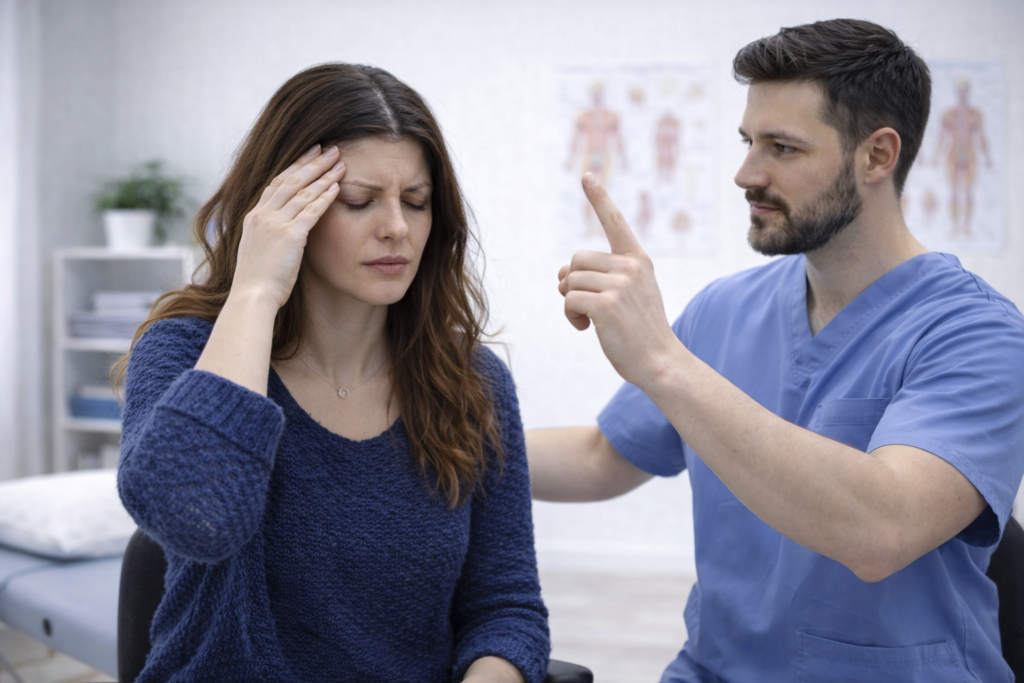
Dizziness complaints can be very limiting in daily activities and can make you feel insecure. There are various causes or conditions that can lead to dizziness. In most cases, the balance organ (vestibular system) is affected. In the case of BPPV, where small crystals float in the organ, these can be repositioned through exercises (Epley maneuver), which reduces dizziness. Sometimes, however, this exercise does not produce sufficient results, or dizziness complaints persist if there is a defect in the balance organ. In these cases, targeted exercise therapy can help reduce dizziness and even make it disappear completely in the long term. Even when there is no clear cause of dizziness complaints, associated imbalances—for example when walking—can be improved.
More information
The purpose of this exercise therapy is to improve abnormalities in the vestibular or balance system through compensation from the central nervous system or brain. The brain interprets information obtained from the vestibular or balance system. When there is an injury or abnormality in a part of this system, the brain needs to be retrained or taught to correctly interpret the information it receives. Vestibular exercises only stimulate the vestibular system. This stimulation produces information that must be processed by the brain. The goal of repeating these exercises is for the brain to learn to tolerate and accurately interpret this type of stimulation. By doing these exercises repeatedly, one can even train the brain to adapt to an abnormal stimulus. These exercises work in nearly the same way as the exercises skaters or dancers do to prevent dizziness when spinning quickly. Simply put, one must seek out and overcome the positions or situations that cause dizziness. Avoiding them only prolongs recovery.
- Training eye movements, independently of the head.
- Practicing balancing in everyday situations with special attention to developing the use of the eyes and muscle sense awareness.
- Practicing head movements that cause dizziness.
- Getting used to natural movement in daylight and in the dark.
- Overall, to encourage rebuilding confidence by making movements easy, relaxed, and spontaneous.